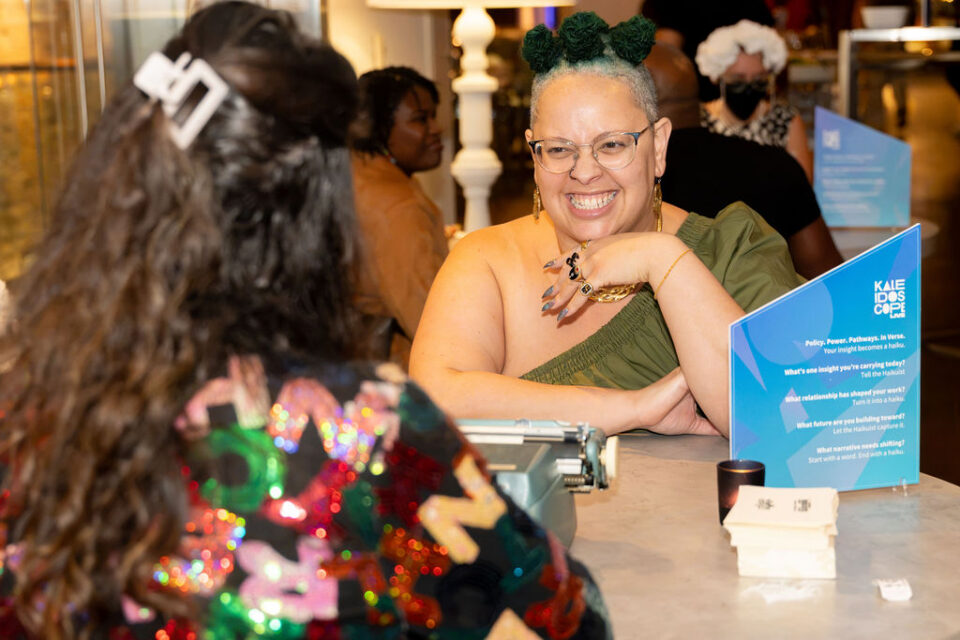
Every two yeasr, Borealis’ Racial Equity in Journalism (REJ) Fund gathers community for Kaleidoscope Live!, a vibrant in‑person summit designed to advance sustainability practices within the BIPOC journalism ecosystem. Through panel discussions, interactive group activities, and networking receptions, the convening amplifies the expertise of the BIPOC journalism ecosystem, deepens relationships between REJ grantees, community leaders, and funders, catalyzes policy development, promotes economic practices that ensure long‑term viability, and facilitates narrative shifts about BIPOC journalism.
This year, at Kaleidoscope Live! 2026, Policy x Power x Pathways, REJ Program Director Alicia Bell opened the event with a reminder that the underfunding of BIPOC-led journalism is not an individual newsroom problem but a systemic market failure that requires collective action, equitable investment, and structural change. Using cultivation as a metaphor, they emphasized the need for patience, trust, shared resources, and long-term collaboration to build a sustainable journalism ecosystem where communities of color can thrive.
You can access their full speech below—and Beyond the Grant, REJ’s new report and sustainability tool.
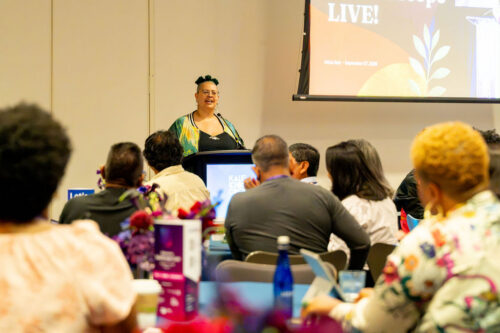
Welcome everyone! Welcome to Kaleidoscope!
I’m so glad to be here with y’all today.
And I want to start by saying something that I hope you feel throughout these next two days:
You belong here.
Not because of the title on your email signature.
Not because of the size of your newsroom.
Not because somebody decided your work was “innovative” enough to invite you into the room.
You belong here because you are part of the work of building a different future for journalism.
And I am deeply grateful to be building that future alongside you.
My name is Alicia Bell. I am a child of Charlotte, North Carolina, and also the child of Chellie, Anderson, Janice, Robert, Silas, Fannie, Rowena, and Winnie Mae.
I am a child of hospitality workers, transformed dopeboys, freelance workers, city infrastructure builders, railroad workers, land tenders, birthworkers, and nurses.
Alongside all of them, many more ancestors I don’t know by name, and all of you, I have the distinct pleasure of cultivating a well-resourced, thriving, maybe even flourishing, ecosystem, rich with Black, Indigenous, Asian, Latine, and Arab led newsrooms.
Now I know that in a lot of spaces, cultivation is cute.
It’s whimsical.
Cultivation is a nice word you put in a grant proposal.
You picture somebody in linen pants, gently watering a little plant while the sun comes up.
But y’all: I grow figs, blueberries, raspberries, blackberries, and mulberries–never mind the one teen and two preteens I’m raising.
Cultivation, my friends, is not always cute.
Sometimes cultivation is weeding.
It’s pruning.
Sometimes it is figuring out why something that was thriving last year has suddenly decided to act brand new.
And sometimes, especially when cultivating something others doubt can thrive, you have to keep tending it with patience and trust, even before visible results appear.
That, to me, is a lot like the work we are doing together.
Because there is something important we need to name plainly:
The problem facing BIPOC journalism is not simply that individual newsrooms need more money.
They do…you do.
But the real problem is that the market itself has repeatedly failed to value, resource, distribute, and sustain journalism created by and for communities of color at the scale our communities deserve.
We have inherited a media economy that has not treated all communities as equally valuable audiences, equally valuable storytellers, or equally valuable sites of investment.
Just ask The Boston Newsletter, often called “the first successful newsroom in America.” How successful would they have been without being the brokering spot for enslaved people?
Or ask the LA Times, which decided decades ago to practice distribution redlining because they didn’t want to deliver to Black & Brown communities.
We know this history.
Black, Indigenous, Latine, Asian, and Arab newspapers built audiences, businesses, institutions, and movements while being excluded from much of the mainstream advertising and financial infrastructure of American media. The first African American newspaper, Freedom’s Journal, launched in 1827; thousands of Black newspapers followed, creating a parallel press because the dominant press did not consistently serve Black communities.
And we can see the consequences in the economics.
The Library of Congress documents, for example, how Black newspapers were targeted by advertising boycotts because of their political positions. The Arkansas State Press ultimately closed in 1959 after white advertisers withdrew their support, despite having a substantial subscriber base.
So when we talk about underinvestment in BIPOC journalism, we’re not talking about some unfortunate accident.
We are talking about a system with a history.
And when the system produces a problem, it is tempting to ask individual people to get better at surviving it.
Get better at fundraising.
Get better at audience development.
Get better at social media.
Get better at monetization.
Get better at doing more with less.
And all of those things may be useful.
But as Rukaiyah Adams of the 1803 Fund has reminded us:
We have market failures, which means we need to transform the market. We can’t solve macroeconomic problems with microeconomic solutions.
That distinction matters.
Because if we believe the problem is simply that individual newsrooms haven’t figured out the right formula, then every newsroom becomes responsible for solving a problem it did not create.
And we end up asking the people who have been most resource-constrained to become the most resourceful people in the room.
Again.
And again.
And again.
I don’t want us to do that.
And I don’t want us to confuse simply putting people in a room together with strategic collaboration.
Because history gives us some warnings there, too.
One thing I have been thinking about is the history of the Congo under King Leopold II.
He told his European comrades that this was an anti-slavery endeavor, an endeavor to strengthen the collective. Instead, Leopold’s colonial project was built through the appropriation of land and resources governed by communal and customary systems, and through economic structures designed to extract value from Congolese labor and resources. The concession system converted land and natural resources into instruments of private accumulation.
And there is a lesson here for us, not that our circumstances are the same, but that collectivity by itself is not inherently liberatory.
People can be organized collectively for extraction.
Resources can be pooled in ways that concentrate power.
Institutions can use the language of community while reproducing the economics of domination.
So the question isn’t simply:
Can we come together?
The question is:
What are we building together, who benefits, who has power, and what becomes possible because we built it?
That is why I don’t think of us as simply participants in a journalism ecosystem.
I think of us as alchemists.
Dreamers.
Weavers.
Transformers.
Builders of the future of journalism.
Because we are not only trying to preserve something.
We are creating something that does not fully exist yet.
And that requires radical imagination.
Baratunde Thurston has said, “Our lives are evidence that radical imagination works.”
Look around this room: We have newsrooms here that are over a hundred years old. We have newsrooms informing tribal nations that have been on their land over a thousand years.
Our lives are evidence.
Every newsroom represented here is evidence.
Every journalist who decided that their community deserved to be seen accurately is evidence.
Every publisher who said, “We’re going to build our own thing,” is evidence.
Every person who has taken a little bit of money and stretched it into something much bigger than anybody thought possible is evidence.
And there is another thing Baratunde has said that I keep coming back to:
“You cannot put your freedom in someone else’s hands to solve. By then, you’ve already given it away.”
For me, that is not an argument against partnership.
It is an argument for agency.
It is an argument for building the capacity, relationships, institutions, capital, and collective power that allow us to shape the conditions in which our work happens.
Because financial transformation and collective transformation have always been connected.
We sometimes talk about money as if it is just a neutral object that sits in a bank account.
But money is infrastructure.
Currency is an agreement about value.
Markets are systems for deciding what gets exchanged, who gets access, and under what conditions.
The United States has repeatedly changed those systems.
We moved through different forms of currency. We fought over whether money should be backed by gold, silver, or both. The United States officially adopted the gold standard in 1900.
The New York Stock Exchange traces its formal origins to the Buttonwood Agreement of 1792, when 24 stockbrokers established rules for trading and commissions.
These systems were not inevitable.
People built them.
People changed them.
People argued over them.
People invested in them.
People benefited from them.
And people were excluded from them.
So when we say we need to transform the economics of journalism, we should remember:
Economic systems are made.
And what has been made can be remade.
That is the work I believe we are here to do.
But remaking systems takes time.
This is where the gardening metaphor comes back.
You cannot plant a fig tree on Tuesday and demand figs on Thursday.
Believe me. I have tried.
You cannot decide that you are cultivating a forest and then dig up the seed every three days to check whether it is working.
And yet so much of our philanthropic and institutional culture is built around exactly that impulse.
Short grant cycles.
Immediate deliverables.
Annual measurements.
Three-year initiatives expected to demonstrate transformation in year one.
We ask people to prove that the tree is healthy while we’re still pulling at the roots.
But culture doesn’t change on a grant cycle.
Ecosystems don’t change on a quarterly reporting cycle.
Trust doesn’t change on a dashboard.
And collective power certainly doesn’t emerge because we scheduled a convening.
Chicago’s journalism ecosystem shows that collaboration and trust can compound over time. MacArthur recently described the growth of collaborative work among nonprofit newsrooms as something built over roughly a decade, a reminder that ecosystem change is cumulative.
Ten years ago, I was training journalists in Charlotte on community engagement 101. Now, journalists lead workshops with artists and bring community members into the journalism classes they teach.
So I want us to think about the next ten years.
Not because ten is some magical number.
But because it gives us permission to think beyond the next grant, the next funding round, the next crisis, the next news cycle.
What would it look like to cultivate this ecosystem for a decade?
What if, ten years from now, we could look back and say:
We built durable institutions.
We changed who gets capital.
We changed who gets to decide what journalism is worth.
We built shared infrastructure.
We built relationships across language, geography, race, generation, and medium.
We made collaboration easier.
We made extraction harder.
We made it possible for more people to tell the truth about their communities without having to choose between doing the journalism and keeping the lights on.
What if we stopped thinking only about how to help individual newsrooms survive—
and started asking what infrastructure would allow an entire ecosystem to thrive?
And that brings me to something I am especially excited to share with you today.
If we are serious about moving beyond the grant, we need more than beautiful language about sustainability.
We need evidence.
We need shared knowledge.
We need tools that help us understand what sustainability actually looks like for BIPOC-led newsrooms.
And we need to make that knowledge available to the people doing the work.
Today, the Racial Equity in Journalism Fund is announcing “Beyond the Grant.”
Everyone received a copy in their bags.
It is a new report and sustainability tool designed to help us look at the conditions that allow BIPOC-led journalism organizations to sustain and strengthen their work over time.
And I want to be clear about why this matters.
This is not a tool for telling newsrooms whether they are “good” or “bad” at sustainability.
It is not another scorecard.
It is not another way to tell leaders who are already carrying enormous responsibility that they need to do more.
It is an invitation to see the whole ecosystem.
To ask better questions.
What does sustainable revenue actually look like?
What kinds of capital are available—and what kinds are missing?
What organizational infrastructure makes resilience possible?
What happens when a grant ends?
What happens when an organization grows?
What happens when it decides not to grow?
What does sustainability look like from the perspective of a newsroom that is accountable to a particular community rather than to an abstract idea of scale?
And perhaps most importantly:
What responsibility belongs to the newsroom, and what responsibility belongs to the funders, investors, intermediaries, and larger market around that newsroom?
Because if the system is part of the problem, the system has to be part of the solution.
The “Beyond the Grant” report and tool are one contribution to that work.
They give us something we can examine together.
Something we can learn from.
Something we can use to challenge our assumptions.
And something we can carry beyond these two days.
Because I don’t want this convening to be a beautiful moment that disappears when we get on airplanes.
I want it to become part of the infrastructure.
Part of the soil.
Part of the water.
Part of what makes the next generation of BIPOC-led journalism possible.
That is the opportunity of these next two days.
Not to come up with one perfect answer.
Not to pretend we have solved the problem.
And certainly not to spend two days admiring the problem.
We are here to learn from one another.
To name what is actually happening.
To share what is working.
To talk honestly about what isn’t.
To identify the resources, relationships, and structures that are missing.
To imagine what we could build together.
And then—to get specific.
Because cultivation requires more than imagination.
It requires water.
It requires soil.
It requires people willing to do the work.
It requires resources.
It requires patience.
And every once in a while, it requires somebody standing next to the garden saying:
“Baby, that is not a weed. That’s the thing you’ve been waiting for.”
[Laughter/pause.]
And maybe that is one of the gifts of a gathering like this.
Sometimes we need other people to help us recognize what is already growing.
Because when you are close to the work, it is easy to see everything that is unfinished.
The deficit.
The gap.
The thing you don’t have yet.
But I want us to spend these next two days looking at the abundance, too.
The relationships.
The ingenuity.
The knowledge.
The journalism.
The people.
The experiments.
The institutions.
The possibilities.
The seeds.
And the trees.
Because no matter how many times my fig-tree pruning is insufficient—
and y’all, it is insufficient—
the figs still come.
And the fig-leaf syrup it produces?
Delightful.
That is my evidence.
The pruning can be imperfect.
The gardener can be tired.
The ecosystem can be under-resourced.
And still—something delicious can grow.
So before we go any further, I want us to do something very simple.
I want you to meet somebody you don’t know.
Not somebody you already came in with.
Find someone whose work, community, geography, or perspective is different from yours.
And I want you to spend about two minutes with them.
Tell them your name, where you’re from, and what you’re cultivating right now.
Not what you’re managing.
Not what you’re struggling with.
Not what you need.
What are you cultivating?
And then I want you to ask them one more question:
What is something you believe is possible in journalism that doesn’t exist yet?
Two minutes.
Meet a neighbor.
And listen for the seed.
Because we may not know yet what all of us are going to grow together.
But I have a feeling we’ll find out.
Welcome to Kaleidoscope.
Let’s get to work.