At this year’s Women’s Funding Network Summit, feminist funders asked what it takes to build and sustain the institutions that let communities write the story of AI on their own terms.
On October 27, more than 130 women’s and gender-expansive organizations gathered in New York City for the Women’s Funding Network Summit: a place where data, technology and power met, and where funders could discuss the means and impact of AI-driven economic restructuring.
We know that AI is reshaping:
- Labor markets,
- Social and political influence,
- Capital allocation, and
- Knowledge and narratives of belonging and shared power.
At Borealis Philanthropy, we believe narrative is one of our most effective forms of infrastructure when resourcing transformation. We believe this because we’ve seen the stories institutions tell shape who gets resourced, believed and protected; they also shape what and who we come to know, as a collective.
Today, most of us are being told the same story about artificial intelligence: that it is inevitable, that it is neutral, and that anyone in conflict or left behind is simply failing to adapt to what must come. That story is deciding whose choice and labor are valued, whose questions get answered, and who’s expected to keep up.
The Summit brought almost 200 people together from 130 organizations, to explore emerging risks and opportunities, build cross-sector alignment, and codevelop strategies of curiosity, bringing our attention to overlapping systems where we might bring our own intersectionality to create greater overlapping solutions.
Big Influence, Bigger Responsibility
Philanthropy has outsized influence within our movement ecosystems, and the Summit was a space to treat that influence as a responsibility.
In the morning’s Great Power Debate, a live poll showed attendees moving from “AI will shift power” toward “AI will concentrate it.” Sarita Gupta of the Ford Foundation reminded the room that the outcome doesn’t belong to the technology. “Algorithms don’t set minimum wages by themselves. Machines don’t decide who profits from productivity. Human beings make those choices.”
Later, Celina Stewart of the League of Women Voters named philanthropy’s part in those choices: “People closest to the consequences have the least amount of power. That’s where philanthropy comes in.”
From Narrative to Practice: Power, Equity, and AI
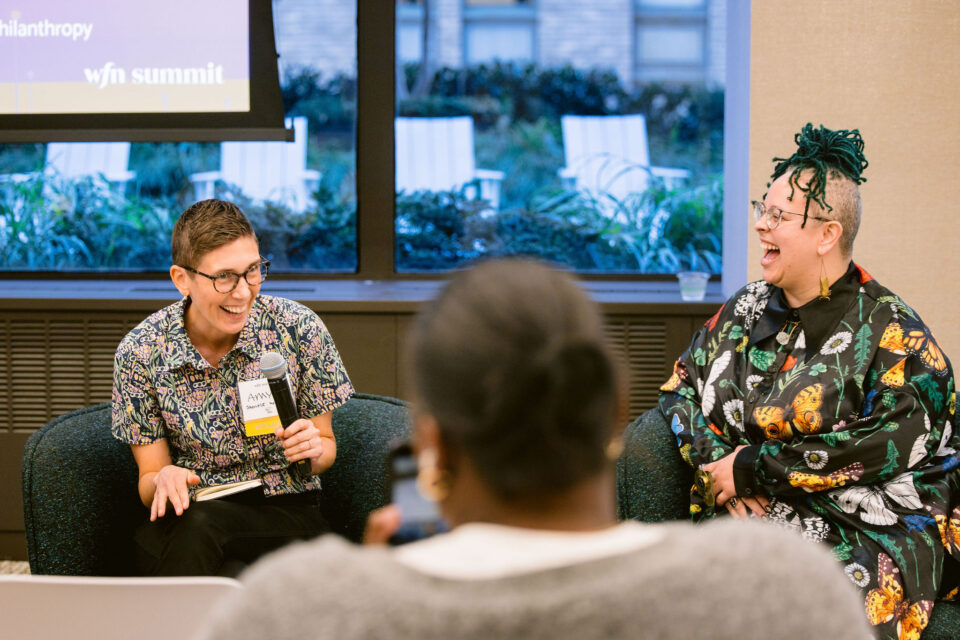
Borealis and the W.K. Kellogg Foundation sponsored the afternoon panel, moderated by Dr. Kholi Murchison, Borealis’ Interim Director of Narrative Strategy and Public Affairs, in conversation with Alicia Bell, Director of the Racial Equity in Journalism Fund at Borealis, and Amy Sample Ward, CEO of NTEN.
Sarah Yates, Vice President and Head of Technology and Integrated Experiences at WKKF, opened by describing how Kellogg is working through AI both as a funder and as an organization adopting it.
“We can’t approach AI as something that’s simply happening to us. We have choices to make, and we have a responsibility to help shape what comes next.”
— Sarah Yates, W.K. Kellogg Foundation
Kholi began with a simple question: What are we being asked to believe about AI? A great deal of money goes into shaping that belief. But we already know how to question a confident machine. We do it every time we override spell check.
“We’re living through a moment when AI is being presented as inevitable, transformative, and increasingly essential to how we work and live. Necessary questions for feminist philanthropy are: ‘Is that true?’ and ‘What do we want to make inevitable?’”
— Dr. Kholi Murchison, Borealis Philanthropy
A survey of more than 900 organizations by NTEN and Bridgespan found that leaders and staff experience AI’s use and risks differently. Independent Sector polling shows the public expects nonprofits to disclose when they use AI.
“What feels true to me are the conversations that we hear workers having across the sector — and I say workers as counter to leadership-level folks in organizations. One really clear pattern in the data is that the closer you are to the impact of your mission — meaning program staff, services staff, folks who are looking at community members — the much more likely you are to say, ‘I will not use generative AI tools.’ The further you are from having to look at your community, the more likely you are to say, ‘Oh, I use it every day.’
— Amy Sample Ward, NTEN
Grounding the conversation in history, and reminding us that radio, newspapers, and social media each entered systems that already distributed power unequally, and each repeated the same harms until people organized for power and repair.
“Most narratives of inevitability are just a way to shut down conversations. AI serves a manifestation of all that we know of neoliberalism: you take something that should be publicly accessible to all people and privatize it, so a smaller amount of people get to benefit from the profit of it. And we must ask ourselves, in our acceptance, ‘Who does this serve?’”
— Alicia Bell, Racial Equity in Journalism Fund
Building Resilient Movements: Organized Abandonment and Relationship
Borealis grantee partner Jenice Fountain, Executive Director of the Yellowhammer Fund, co-facilitated Collective Strategy Lab 2: Building Resilient Movements with WFN research partner Abby El-Shafei. The Lab previewed WFN’s 2026 State of the Field Report, drawn from its DataWoven resource. One finding: 69.4% of organizations led by women and nonbinary people of color were founded between 2005 and 2024. Many are still building their foundations.
Participants named what threatens those foundations: funding cuts, targeted attacks on fiscal sponsors, the weaponization of data, and a $200,000 budget threshold that shuts smaller groups out entirely. Jenice put the pattern plainly:
“Philanthropy engaged in organized abandonment framed as risk aversion.”
— Jenice Fountain, Yellowhammer Fund

Jenice Fountain
Her answer was relational. Movements outlast attack when funders stay close and stay in it together.
“Being in relationship is an asset in a colonial society.”
— Jenice Fountain, Yellowhammer Fund
What Funders Owe the Field
Philanthropy can’t correct the story of AI from the sidelines, and no funder can do it alone. Communities get clarity when they have their own institutions for making meaning: newsrooms, data projects, technology intermediaries and trusted networks. That capacity remains underfunded and fragmented. It’s resourced cycle by cycle, while the dominant story is funded for decades. Belonging requires narrative institutions that last.
For feminist philanthropy, the responsibility looks like this:
- Fund the infrastructure, not just the response. Back the journalism, data and technology organizations that help communities name what is happening to them, before the rules are written.
- Fund for the long term. Give patient, multi-year capital, not support that retreats at the first sign of risk.
- Fund your values into the tools. What we use, buy and build carries our values, or someone else’s.
At Borealis, this is the work of our collaborative funds, including the Racial Equity in Journalism Fund, which resources BIPOC-led news and information institutions so communities can tell their own stories and hold power to account. We’re grateful to the Women’s Funding Network for convening this community, to the W.K. Kellogg Foundation for partnering with us, and to Yellowhammer Fund and every organizer and funder who brought their questions into the room.
The future is being designed. Let’s fund the people already designing it.
Join the Movement for Change / Donate or Partner with Borealis